The Lovell Quinta Arboretum
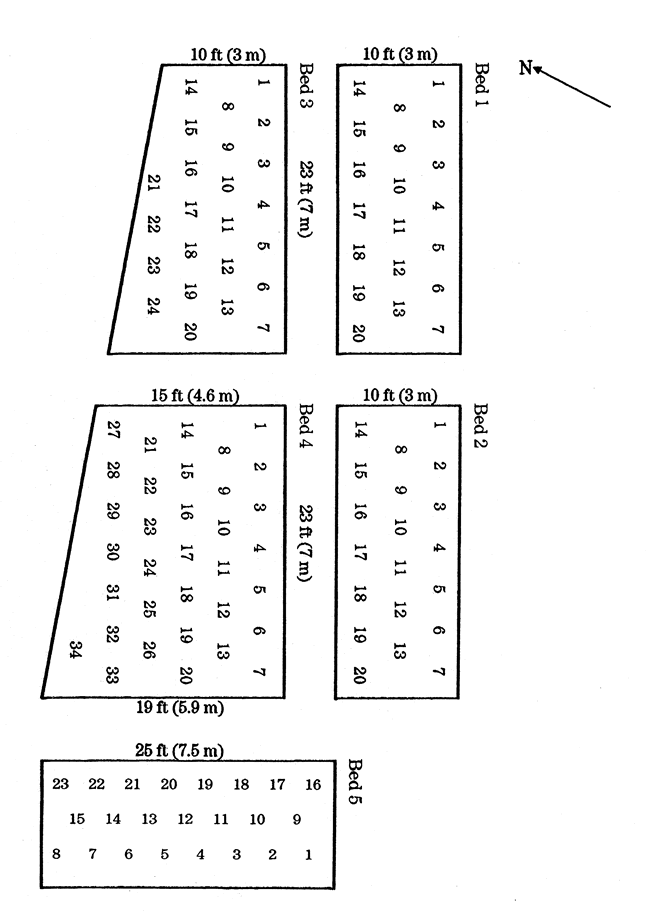
Hebe Beds July 2014
|
Hebe Bed 1 |
Hebe Bed 2 |
|
Hebe Bed 3 Hebe Bed 5 |
Hebe Bed 4 |
These include a number of older cultivars, which are now less readily available.
 |
 |
|
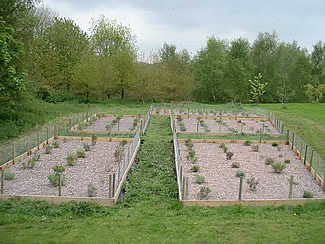
Hebe beds on 9th May 2004 |
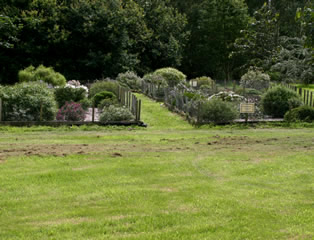
Hebe beds on 10th July 2007 |
Hebe Beds at The Lovell Quinta Arboretum, Swettenham, near Congleton, Cheshire, UK
November 2003
John and Pat Saville and I assembled the Hebe Display Beds.
These were made by laying out the plastic sheeting, putting stakes through each
corner, and nailing the boards to the stakes. The plastic sheeting was trimmed and covered with 7.5 tons of gravel.
May 2004
Friday 8th – the beds were completed, and over the next two days over 120 hebes were planted
June 2004
We visited the beds at the beginning and at the end of June. Grass and nettles
had grown up between the beds, although there were few weeds in the beds. About
30 hebes in flower were photographed.
August 2004
We put up notices on each bed naming each hebe. The beds have created a lot of interest and favourable comments from visitors to the Arboretum.
September 2004
We edged the beds to remove grass and nettles, and afterwards photographed hebes in flower – always a good
number of these.
October 2004
Saturday 9th – we weeded the beds, edged around them, and photographed hebes in flower.
There were large numbers of hebes in flower, and these were being visited by
several comma butterflies, and a goodly number of bees. A few hebes are doing
poorly (Hebe ‘Edington’ and Hebe ‘Blue Clouds’), but some seem to have picked
up from our last visit.
January 2005
Saturday 8th – we paid a quick visit, due to strong westerly winds.
Most hebes were OK, although some were suffering from the weather, and a few
had the odd flower.
March 2005
Saturday 19th – replaced all laminated signs, pulled up weeds in beds, evaluated all hebes for
appearance (eight are apparently dead).
April 2005
Wednesday 6th – met John Saville at Hebe Beds. He had brought 17
hebes dead hebes, and ones that were doing poorly.
May 2005
Wednesday 11th – we edged and weeded the grass around beds, weeded
the beds, tidied up a number of hebes. We then photographed all 8 hebes in flower,
and then photographed all the hebes as a record.
July 2005
We visited on Wednesday 27th when there were only 17 hebes in flower. Hebe ‘Beatrice’ was covered
in white flowers and could be seen from a long way.
September 2005
Wednesday 14th – edged grass around beds, weeded beds, some hebes dead-headed, photographed all
hebes with digital camera, and beds with film camera.
October 2005
Tuesday 4th – edged grass around
beds, weeded beds (very few weeds), and photographed the hebes in flower.
April 2006
Tuesday 4th – weeded beds, raked out dead leaves, edged beds,
photographed all hebes, evaluated amount of foliage on each hebe. Most are totally
defoliated, but few are bark split.
May 2006
Tuesday 23rd – weeded beds, pruned hebes, and evaluated hebes (31
OK, 24 recovering and 68 dead) several are in flower, and several have flower
buds.
June 2006
Friday 9th – I edged the beds,
pruned hebes to tidy, weeded beds (only two weeds found), checked that all hebes
marked as dead in previous evaluation were still dead, they were.
Tuesday 13th – we planted some new hebes and finished planting at about 2.00pm. Overall we had dug out and planted nearly 70 hebes.
Wednesday 28th June – I edged the beds, weeded beds, photographed all hebes and took closeup photos of those in flower, and added new bed labels, removed debris from previous hebes and pruned hebes.
July 2006
I visited the beds in July to photograph hebes in flower, and pruned and pinched out all hebes. All the new hebes were growing well and those damaged by the winter were recovering. I met a local resident who said he had had -12°C during the winter, no wonder our hebes had suffered.
April 2007
Wednesday 4th – weeded all beds - there were quite a few weeds due to the mild winter.
Wednesday 11th – the worst hebes were evaluated; there were 3 dead and 3 in very poor condition.
Saturday 14th – using Tatton Garden Society’s rotary mower I mowed between beds. I put up new hebe bed notices, repaired fencing and cut back Hebe ‘Kew Feather’, which was encroaching on Hebe ‘Lavender Queen’. Hebe ‘Kew Feather’ and Hebe ‘Rosemergy’ are doing well.
May 2007
Saturday 19th – we trimmed the grass around and between beds, weeded beds, there were very few weeds, and pruned some hebes. We replaced 4 very poor or dead hebes. I photographed all hebe beds and hebes in flower.
June 2007
Friday 1st – we reduced the grass around the beds and weeded the beds. We pruned hebes encroaching on others, removed dead branches and photographed hebes in flower.
June 2007
Tuesday 10th – we edged beds around and between beds. We weeded the beds, only 6 weeds were found, then photographed all hebes in flower, and general views of the beds.
Wednesday 18th – we edged the grass around and between beds and weeded beds. I took photos of hebes in flower. We replaced Hebe ‘Pink Spice’, which was in very poor condition, with Hebe ‘Twisty’.
Sunday 29th – we edged the grass around and between beds, weeded beds, pruned and deadheaded hebes. I photographed all hebes in flower. Throughout our time there we saw numerous butterflies.
April 2008
Friday 4th – we edged the grass around the beds, and weeded the beds.
We evaluated the hebes; there were 5 dead and 8 in poor condition. Hebe
‘First Light’, Hebe ‘Karo Golden Esk’, Hebe
‘Silver Dollar’ and Hebe ‘Sweet Kim’ were in
such good condition that they were photographed. Hebe ‘Pewter
Dome’, a rooted cutting from home that I had added in May 2007 to fill
a vacant space, had grow well since then. Hebe ‘Gibby’
another refugee from our garden had done well.
Wednesday 16th – we removed few weeds, pruned poor hebes and cut back Hebe ‘Kew Feather’, which had grown too large. We replaced 8 very poor or dead hebes: Hebe ‘Bowles Hybrid’ by Hebe elliptica ‘Anatoki’, Hebe ‘Killiney’ by Hebe ‘Hadspen Pink’, Hebe ‘Mystery Red’ by Hebe ‘Miss E Fittall’, Hebe ‘Pink Pixie’ by Hebe ‘Valentino’, Hebe ‘Purple Prince’ by Hebe ‘Greensleeves’, Hebe ‘Perry’s Ruby Leaf’ by Hebe venustula ‘Blue Sky’, Hebe ‘Ritt’ by Hebe ‘Nantyderry’. I photographed Hebe ‘Karo Golden Esk’, Hebe ‘Miss E Fittall’, Hebe ‘Silver Dollar’ and Hebe ‘Sweet Kim’.
May 2008
Wednesday 21st – we edged the grass around and between beds, and updated
all five bed labels. All beds and plants were photographed. We had a number
of visitors who made favourable comments about the hebe beds.
July 2008
Monday 14th – we edged the grass around the beds, weeded the beds, deadheaded Hebe ‘Gibby’, and pruned Hebe ‘White Paradise’ and Hebe ‘Pearl of Paradise’. The hebes in flower were photographed, although many were going over. We also took cuttings of Hebe macrantha and Hebe ‘Gibby’ for Society member Chris Barnett.
August 2008
Sunday 3rd – we arrived, not having realised that it was Open Day for the National Gardens Scheme. The organisers on the gate said it was alright to go ahead with our proposed maintenance and made sure that all visitors were directed to see the lake and our Hebe Beds. The grass around and between the beds had been mowed for the Open Day, so just some edging was needed. There were a few weeds in the beds, which Margaret dispatched. The two hebes that caught most visitors’ eyes were Hebe ‘Wiri Prince’ with large plumes of mauve flowers and Hebe ‘Vogue’ with large plumes of red flowers.
The main work undertaken was pruning hebes that had flowered or had become too large or straggly. This was interrupted by a steady stream of visitors: people, bees and butterflies. The people commented on how good the hebes looked, and had not realised that there were so many different ones available. Most hebes in flower had bees on them. The butterflies were large white, gatekeeper, meadow brown and speckled wood. It was noticeable that the butterflies disappeared when rain threatened and reappeared when the sun came out. We were very pleased to see that the two refugees from our garden, Hebe ‘Gibby’ and Hebe ‘Pewter Dome’ were flourishing and indeed had flowered well.
April 2009
Monday 13th – I edged the grass around the beds and weeded the beds. The hebes were evaluated and I found that there were 20 apparently dead, and 10 were in poor condition.
May 2009
Friday 29th – I edged and weeded beds, and cut back the two largest dead looking hebes to reduce their visual impact. One of these is Hebe ‘Midsummer Beauty’ which is breaking in several places. Hebe ‘Gibby’, which was rescued from our garden, is just coming into flower. Hebe ‘Pewter Dome’, also rescued, is growing well.
June 2009
Monday 8th – I met Rhod Taylor, he planted 13 hebes. This is not as many as originally thought, as several hebes had started growing since the evaluation on 13th April. I pruned some of the worst hebes, and used a spade to remove soil lifted by moles on the front edge of the beds. This soil had been colonised by grass and buttercups and looked unsightly.
Saturday 13th – I pruned (tidied) some more hebes. All hebes were valuated and these in flower were photographed, including Hebe ‘Gibby’.
Tuesday 30th – I edged bed 4 and bed 5 with a spade to remove mole hills, and then edged the grass around all beds. Hebe ‘Sonja’ was planted in bed 3 to replace Hebe ‘Pearl of Paradise’, which was in very poor condition. I noticed that Hebe ‘Midsummer Beauty’ was making little progress and that Hebe ‘Carnea’ now appeared dead (on the last visit it seemed to be recovering).
July 2009
Saturday 4th – I edged more sides with spade to remove mole hills, and then pruned a few hebes. All hebes were photographed as a whole, and several in flower in close-up.
August 2009
Sunday 2nd – I edged grass round the beds, weeded the beds (which included hebe seedlings), and replanted Hebe ‘Carnea’ to replace the specimen that had died. Some hebes were pruned and/or dead-headed.
Saturday 8th – I spent a little time edging the grass round beds (which had been mowed by volunteers from Swettenham Village), then weeded the beds, and pruned and/or dead-headed some hebes.
September 2009
Wednesday 16th – I edged the beds, which had been mowed. There were quite few weeds that needed removing. Various hebes were pruned or pinched out, to keep them compact. I used shears to clip Hebe ‘Spender’s Seedling’ and photographed it. This picture was used in the hebe talk given in October. I also photographed several recovering plants: Hebe ‘First Light’, Hebe ‘Midsummer Beauty’ and Hebe ‘Valentino’.
October 2009
Friday 30th – I edged and weeded the beds. There were twelve hebes with various amounts of flowers, but Hebe ‘Anomala’ was fully in flower. The beds were visited by two members of the International Dendrology Society, who were conducting a reconnaissance prior to a meeting in 2011. Later I was visited by Sir Bernard Lovell and his daughter.
April 2010
Thursday 8th – I edged the grass around the beds and weeded the beds. The hebes were evaluated and I found that there were 30 apparently dead, and 20 were in poor condition.
Thursday 29th – I evaluated the hebes, a few were better, but more now looked dead. I pruned Hebe stricta var egmontiana and Hebe ‘Kew Feather’. These are large, dead looking plants that strike visitors as they arrive. I went to prune Hebe ‘Christensenii’, which had some dead branches, and found a bird’s nest with four blue eggs, so I left quickly.
May 2010
Thursday 13th – I edged and weeded beds, and cut back the two largest dead looking hebes to reduce their visual impact. These are Hebe parviflora ‘Holdsworth’ and Hebe traversii, both of which are breaking from the base. All hebes were evaluated and photographed. The eggs in the nest in Hebe ‘Christensenii’ have hatched into what I thought were great tits. Peacock and speckled wood butterflies flew by, although it was not too early in the year for hebe flowers.
Thursday 20th – all hebes were evaluated. Four hebes were dug out and replaced. Three hebes were cut to the ground and one was pruned to tidy it. The nest in Hebe ‘Christensenii’ was now empty, hopefully the chicks had flown.
Thursday 27th – four hebes were dug out and replaced. Three hebes were pruned, and while cutting Hebe ‘Kew Feather’ to ground I found it was breaking from the base. This hebe was found, named and introduced by our founding Secretary, so it’s that it is good staging a recovery in a colder climate. The hebes replaced and pruned today were those most visible to visitors.
Registered Charity No 801398
